An SLA is not a timer: why citizen service needs escalation governance
Municipalities often adopt service-level agreements because they want to make response more predictable. The intention is right: define time commitments, reduce improvisation, and make the institution more accountable to citizens.
But an SLA by itself does not govern a service. A timer can count how long a case has been open. It cannot decide who owns the next action, whether the case is blocked by a dependency, whether field evidence is sufficient, whether a contractor is late, whether the citizen should receive an update, or whether the backlog is becoming a structural risk.
That distinction matters. In citizen service, deadlines only create institutional value when they are connected to ownership, escalation, evidence, and correction. Otherwise, the municipality has a more precise clock, but not necessarily a better operation.
Why the problem matters now
The pressure on municipal service teams is not only volume. It is the combination of more channels, more visible expectations, more departments involved in the same request, and less tolerance for uncertainty.
A citizen may report the same issue through a call center, app, WhatsApp, service desk, or social media. A single report may require intake validation, departmental review, field execution, contractor participation, photographic evidence, supervisor verification, and citizen communication. The public does not experience that as seven separate internal steps. It experiences one service.
That is why service delivery guidance has moved away from thinking only in terms of isolated transactions. OMB Circular A-11 Section 280 frames public service delivery as the coordinated set of interactions through which a person obtains, receives, or uses a public offering. It also treats customer experience as more than speed, including effectiveness, quality, ease, transparency, trust, and employee helpfulness.
The OECD reaches a similar operational conclusion in its Good Practice Principles for Public Service Design and Delivery in the Digital Age. It argues that public services should solve whole problems, map user journeys, data flows, and organisational responsibilities, and make channels coherent rather than simply adding more entry points.
For a municipality, the implication is direct: an SLA cannot be treated only as a deadline. It has to become the rule system that keeps the service chain moving.
Where SLA failure appears in daily operations
The weakness rarely appears as a single dramatic breakdown. It shows up in ordinary service workflows.
A deadline exists, but ownership is unclear
A case may have a target response time, but if ownership is still resolved through calls, personal knowledge, or informal reassignment, the SLA is not governing the operation. It is only measuring delay after the fact.
The right question is not only "how much time remains?" It is "who is responsible for the next verifiable action?"
The case changes queues without changing accountability
Many municipal services cross departments. A streetlight case may touch citizen service, public works, a contractor, and supervision. A water leak may involve intake, technical validation, a field crew, and citizen follow-up.
If every handoff resets context or leaves the prior actor unclear, the SLA becomes fragile. Time keeps running, but responsibility becomes distributed across partial views.
A status changes without enough evidence
The system may say "in progress" or "resolved." But if the closure lacks field evidence, timestamp, responsible user, location validation, or supervisor review, the SLA can be satisfied administratively while the service remains weak operationally.
In that case, the municipality is not measuring resolution. It is measuring declared resolution.
Backlog hides inside averages
Averages can make the operation look healthier than it is. If most simple cases close quickly while older, complex, or cross-department cases accumulate, the SLA dashboard may report acceptable performance while citizens with difficult cases keep waiting.
Backlog age, repeated reassignment, breach reasons, and stuck queues matter because they reveal where the institution is losing control.
Citizens receive silence instead of service continuity
A missed SLA is not only a management problem. It is also a trust problem. When the citizen does not know whether the report was received, assigned, delayed, corrected, or closed with evidence, uncertainty becomes part of the service experience.
This is why escalation governance has to include communication, not only internal alerts.
What a modern institutional response looks like
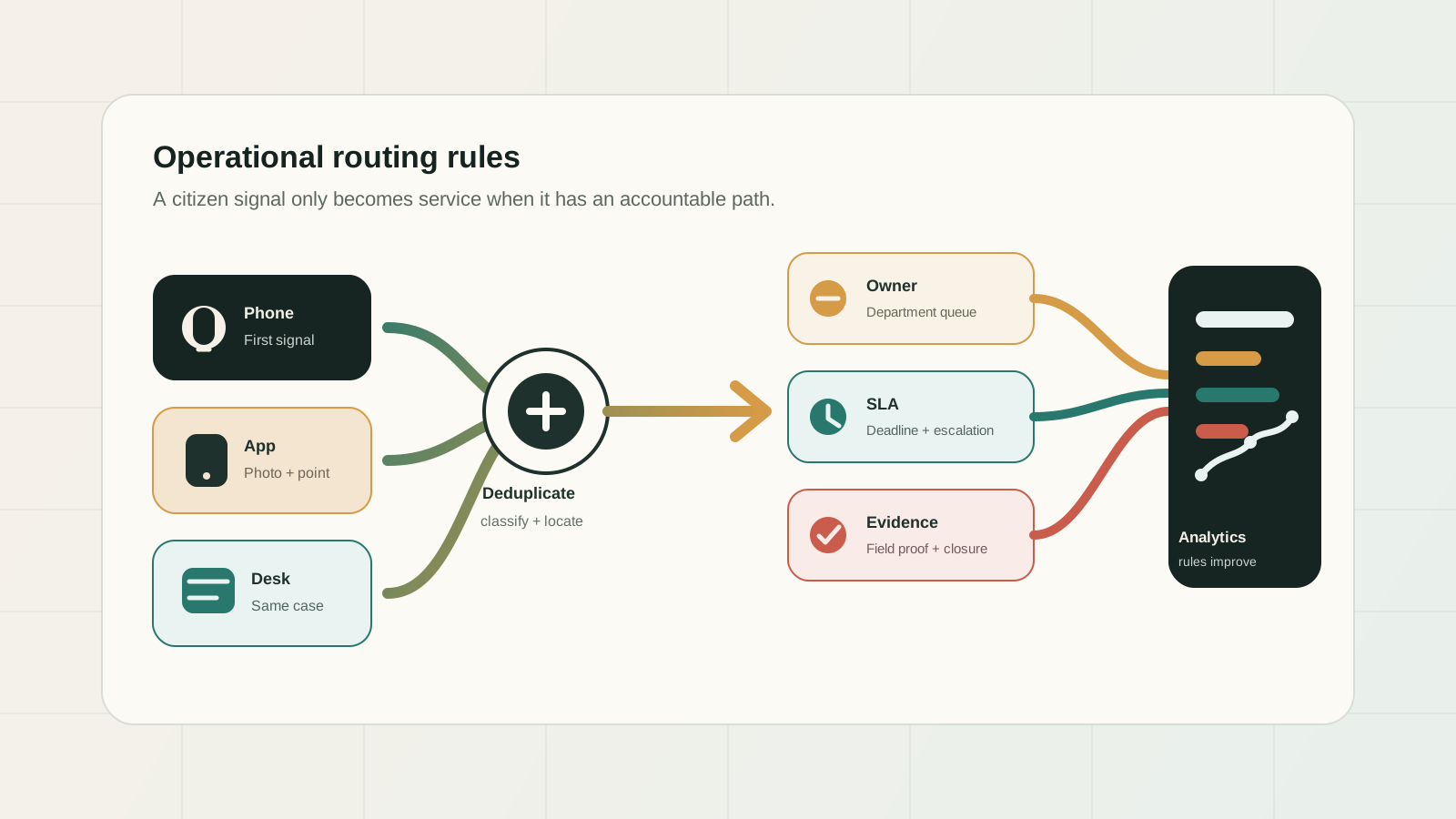
A mature citizen-service operation treats the SLA as an operating rule, not a decorative metric. That means at least six capabilities.
1. Case identity from intake
The SLA should attach to a real case, not to scattered reports from separate channels. Deduplication and case identity matter because one physical problem should not become five competing clocks.
2. Clear responsibility for the next action
Every state of the case should answer a concrete question: which team, desk, crew, contractor, or supervisor owns the next step? Without that, escalation becomes noise.
3. Escalation rules tied to service context
Escalation should not be a generic warning. It should reflect case type, priority, zone, department, dependency, evidence requirement, and the time already spent in each state.
4. Evidence-based closure
A service should not close only because the timer ended or a status changed. It should close with enough evidence to support the decision: field notes, photos when relevant, timestamp, responsible actor, and validation logic.
5. Citizen communication built into the flow
Updates should not depend only on a citizen calling again. The workflow should be able to communicate receipt, assignment, delay, progress, and closure with the same operational truth used internally.
6. Analytics that explain why time was lost
The most useful SLA data is not simply the percentage of cases resolved on time. It is the reason time was lost: poor classification, weak intake, dependency on another department, contractor delay, missing evidence, repeated reassignment, or insufficient capacity in a zone.
That is where SLA measurement becomes institutional learning.
| Timer-only SLA | Governed SLA |
|---|---|
| Counts days open | Connects time to ownership, state, and next action |
| Measures averages | Reads backlog age, stuck queues, breach causes, and recurrence |
| Allows administrative closure | Requires evidence and validation before closure |
| Sends generic alerts | Escalates by priority, dependency, department, and field context |
| Leaves citizens waiting for updates | Communicates progress and delays from the live case |
| Produces performance reports after the fact | Helps supervisors correct the operation while the case is still active |
Why this is directly relevant to Agora
This is where Agora fits Intello's institutional position.
Across Intello's product language, Agora is not described merely as a portal for receiving reports. It is positioned as a citizen-service platform for omnichannel intake, intelligent deduplication, routing, traceability, citizen transparency, team and vendor management, real-time dashboards, territorial heat maps, and performance metrics.
That matters because an SLA cannot be governed from a disconnected spreadsheet. It needs the same operational layer where the case is born, assigned, executed, evidenced, communicated, and measured.
The Torreón citizen-service case makes the lesson more concrete. It describes an operating model with multichannel intake, department management, SLA control, comprehensive auditing, proactive communication, field evidence, role-based views, and performance analytics. The broader lesson for other municipalities is clear: service deadlines become useful when they are embedded in the workflow that actually resolves the case.
Seen this way, Agora's value is not that it can show a countdown. Its value is that it can help the institution connect the countdown to responsibility, evidence, escalation, and decision quality.
The institutional lesson
A municipality does not become more accountable just because it defines response times. It becomes more accountable when those response times are governable.
That requires a service operation where the institution can answer:
- who owns the case now;
- what condition must be met next;
- why the case is delayed;
- what evidence supports closure;
- what the citizen has been told;
- and what the pattern says about capacity, coordination, or demand.
That is the difference between measuring service and governing service.
An SLA is useful only when it gives the institution time to act, not just a number to explain later. If your municipality is reviewing how to make service delivery more traceable, measurable, and accountable, explore Agora, review the Torreón citizen-service case, or request a demo.
Sources:
- OECD, Good Practice Principles for Public Service Design and Delivery in the Digital Age, published on November 8, 2022.
- Performance.gov, A-11 Section 280 Explainer, guidance overview for managing customer experience and improving service delivery.
- Performance.gov, Terms and Definitions, supplementary material for OMB Circular A-11 Section 280.
An SLA stops being a clock when it helps the municipality move ownership, evidence, and accountability before the service fails.